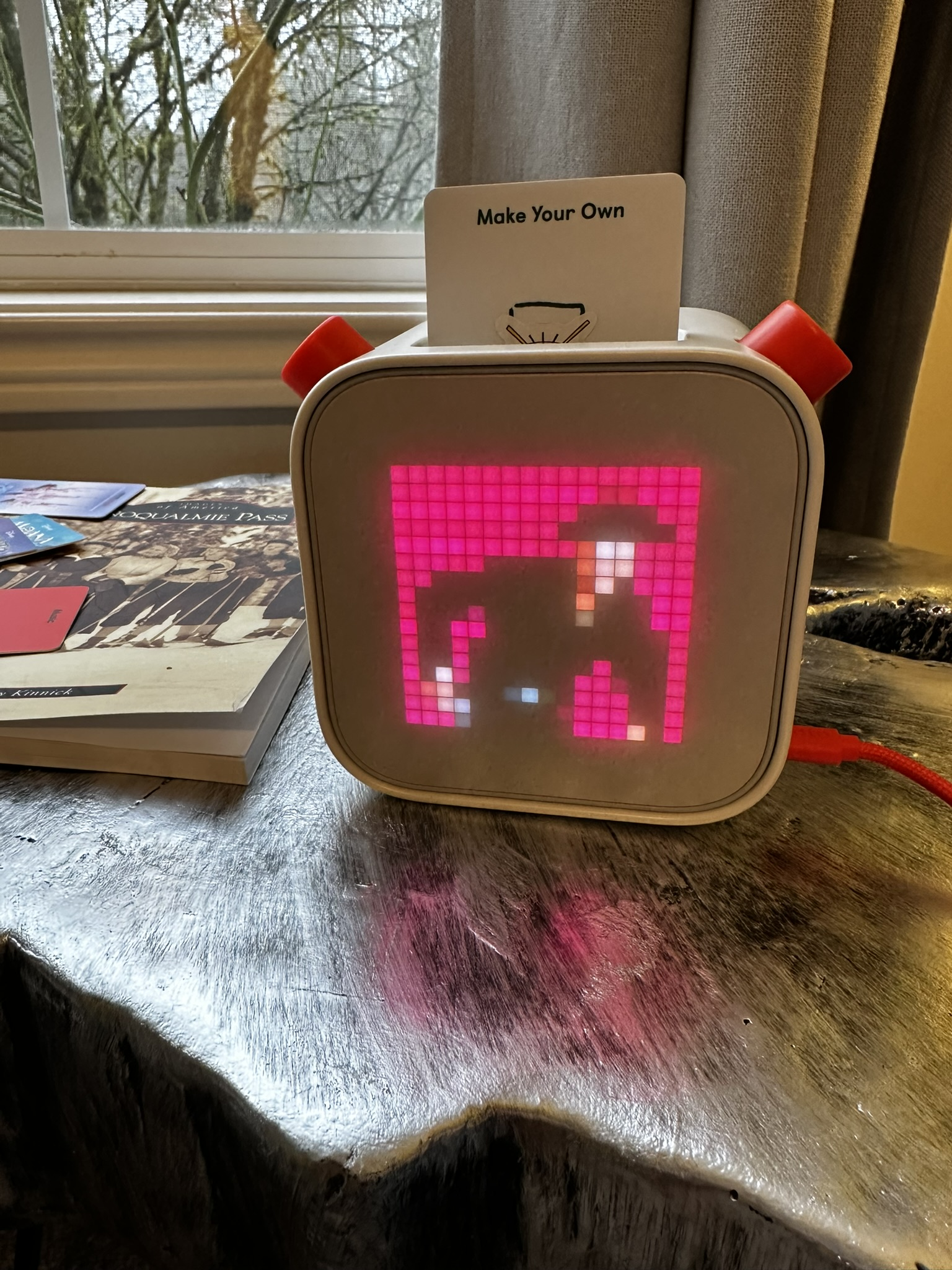
Santa brought my daughter a Yoto player so she can choose the music she listens to. The music is linked to cards that you insert to the player. The cards don't hold any actual data are instead just an NFC chip that tells the player what music and artwork to download and play. It's a clever little device and I really like it so far. Another great feature is that you can create custom cards from MP3s and your own pixel artwork.
My daughter is obsessed with Marty Robbins "Gunfighter Ballads and Trail Songs". It's a really great album that we listen to on vinyl all the time. So my first task on Christmas was to load a custom card with the album and make some custom artwork. I won't go into detail on how I did the MP3s, but for the background image, I decided to vibe code a tool to take an image and downscale it to a 16x16 pixel png file. I used Claude Code to create the tool and had to go through quite a few iterations to work the bugs out of the crop selection tool.
Anyways, here is the final result showing good ol' Marty going for his "Big Iron" on the Yoto! Yoto Player Background
Over the past few months, I have been getting back into playing guitar after a fairly long hiatus. I even started taking guitar lessons. My practice has involved playing a lot of bluegrass fiddle tunes and learning carter-style arrangements of old country and bluegrass songs.
Playing bluegrass with others involves playing solos, or "taking breaks". This just means improvising over the melody of the song. As I've been inching closer toward working on my own improvisational skills, I've realized that I don't have as much intuition about what each interval in the chromatic scale truly sounds like. I want to get to the point where I can listen to a song and recognize when the 4th chord is played vs the 5th or in a break when someone adds in a flat 5.
To help myself train my ear to recognize each interval, I vibe coded a tool using Claude code. The page has two main parts: play each interval at your own pace and a quiz that will play intervals at random and you have to choose the correct one. I also added some descriptions to the intervals to help myself think about what those intervals feel like. There is also a toggle to show the "blue notes".
This is one part of my journey to being able to both improvise better but also transcribe music faster.
I've created a subdomain for this blog to host tools that I vibe code so I can access them anywhere and share them with others. It's built using GitHub Pages and Jekyll.